
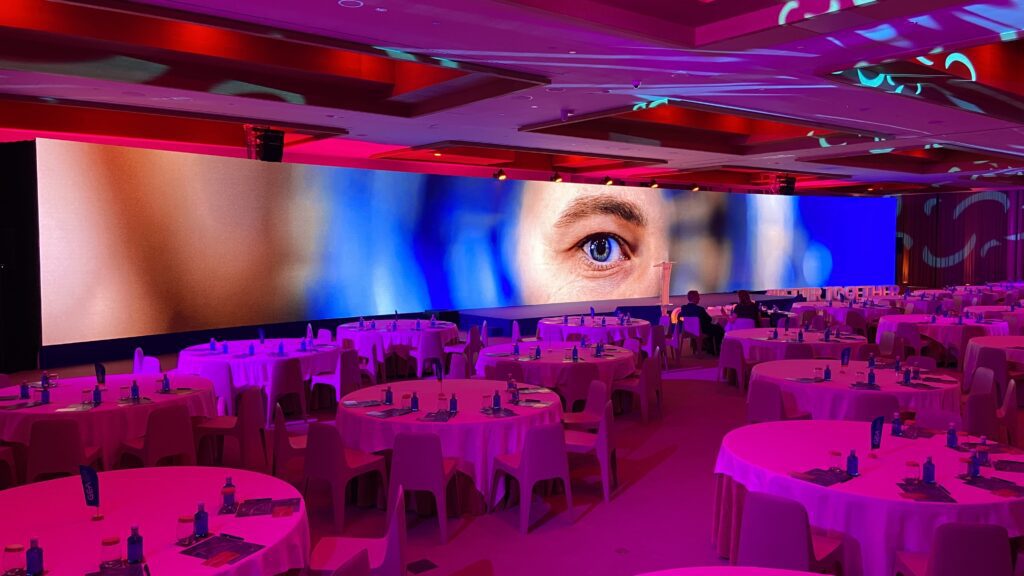
LED screens have revolutionized the way messages are communicated during corporate events, festivals, fairs, congresses and more. However, many times the mistake is made of focusing only on the rental or installation of the equipment, and the most important thing is left aside: the content displayed on that screen.
Content is not a simple companion. It is the focus of attention, The way in which your brand, your message, your product or your concept is presented to hundreds or thousands of people. If it is not well designed, no matter how big or modern your screen is, the result will be disappointing.
At VA 361 Productions, We understand that the real value of an LED display is in its ability to tell visual stories with precision and creativity. Throughout this article we will show you why you should invest in personalized content and how to do it right.
What is customized content for LED displays?
Customized content for LED displays is any audiovisual material created specifically to suit the technical and visual characteristics of a given LED screen. This includes:
Accurate resolution
Aspect ratio
Environmental lighting conditions
Duration of projection
Visual styling and branding of the event or the brand
It is tailor-made content, like a suit that fits perfectly in the projection space and meets strategic objectives.
How is it different from generic content?
Often attempts are made to project PowerPoint presentations or vertical social media videos on large-format horizontal screens. This results in:
Image distortions
Black margin or empty space
Cut or illegible text
Loss of quality or impact
Customized content avoids all this because it is builds from scratch with the projection environment in mind and the public that will see it.
Technical aspects to consider
LED display resolution and dimensions
LED displays have a specific resolution that depends on the number of physical pixels (LED modules) and their size. It is essential to know these parameters before creating the content:
Pixel Pitch (P): distance between the center of one pixel and another (measured in millimeters). The smaller the value, the higher the resolution.
Total resolutionis calculated by dividing the total screen size by the pitch.
For example, a 6 meter wide by 3 meter high screen with a pitch of 3.91 mm will have an approximate resolution of:
Width: 6000 mm / 3.91 mm = 1,534 pixels
Height: 3000 mm / 3.91 mm = 767 pixels
The content must be designed to that resolution exact to avoid problems.
Refresh Rate
This is the speed at which the display updates the image per second. Professional LED displays usually have frequencies of 3840 Hz or higherwhich allows:
Avoid camera flickering.
Maintain a stable display in live transmissions.
Reproduce smoother motion effects.
The content must be produced at a frame rate. compatible with this frequency.
Brightness, contrast and readability
Outdoors, brightness should be high (minimum 5000 nits) and colors should have high contrast to be visible. Some recommendations:
Use dark backgrounds with clear text or vice versa.
Increases the thickness of the text (bold).
Do not use similar colors (e.g., yellow on white).
Ensure that texts are sized to be seen from a distance.
Formats and coding
The recommended formats are usually:
MP4 (códec H.264 or H.265) for compatibility and compression.
MOV in case of specific quality requirements.
Image sequences for loops or complex visuals.
It is also vital to optimize file weight without sacrificing quality, to avoid playback delays.
Custom content types for LED displays
LED displays offer a versatile and dynamic platform for displaying all types of visual content, from simple advertisements to complex immersive experiences. Customized content not only adapts the message to the screen, but also optimizes the interaction with the audience, maximizing the impact of the event. Here we explain the most effective content types for LED displays.
The high-resolution corporate graphic animations are a powerful tool to convey dynamic and visually appealing messages. This type of content is ideal for corporate events, presentations, brand launches and exhibitions.
Advantages:
Captivates attention of the audience with movement and visual effects.
Reinforces the corporate identity, the product can be customized with brand colors, logos and typography.
It makes the presentation more dynamic and memorableavoiding the monotony of static texts.
Elements that usually include:
Animated text: Titles, slogans or animated key messages to highlight important information.
Graphics and icons: Visual elements that simplify the understanding of complex concepts.
Transitions: Effects that facilitate the smooth transition from one slide or section to another.
2. Synchronized visuals for shows and concerts
At concerts, festivals and mass events, LED displays not only serve as a display tool, but also as a fundamental element in the atmosphere of the event. The visuals synchronized with the music (also known as “VJing”) create a unique visual and sensory experience, keeping the audience engaged throughout the event.
Advantages:
Total immersion: Visual content is synchronized to the rhythm of the music, amplifying the audience's experience.
Vibrant and emotional: Creates a unique atmosphere that connects emotionally with the attendees.
Interactivity: Visuals can respond to audience interactions, creating a dynamic environment.
3. Explanatory and demonstrative videos
The explanatory and demonstrative videos are essential for corporate, academic or trade show events where the public needs to know that clear and understandable information about products, services or concepts.
Advantages:
Clarity: Well-designed videos break down complex information in a simple way.
Visual interactivity: They use graphics, animations and text that make the experience easier to digest.
Improves information retention: The combination of visual and audio elements improves memorization and comprehension of the message.
4. Real-time interactive content
Interactive content allows the audience to engage directly with the event. This type of content is particularly popular for events where a dynamic and participative experience is soughtThe use of the product in brand activations, interactive exhibits or trade show booths.
Advantages:
Increased participation of the public, who feel they are an active part of the event.
Personalized experience: Interactions can generate content that adapts in real time to audience responses.
Promotion of social interaction: Attendees can see their messages or photos projected on LED screens, creating a sense of community.
5. 3D content and immersive animations
The latest generation of LED screens can project content on 3D or immersive video formats. This type of content is very effective for technological events, art exhibitions or product launches where the innovation is key.
Advantages:
Depth and realism: 3D content creates a sense of immersion and space that engages the audience.
Visual impact: The projection of 3D animations or volumetric images has a profound impact on the viewer.
InteractivityIn some cases, 3D content may react to the presence or movements of the attendees.
6. Live video content and real-time broadcasts.
For events that include speakers, artists or live presentationsthe content of real-time video is crucial to transmit what is happening at the event to the audience present and to those following remotely.
Advantages:
Increased coverage: LED screens allow all attendees to clearly see the stage, even from remote positions.
Transparency and accessibility: Important details or key moments of the presentations can be highlighted for the whole audience.
Global connection: For hybrid events, live streaming connects in-person audiences with those who are following the event virtually.
Common mistakes when using LED displays without customized content
Using LED displays without adequate customized content is a mistake that many event organizers make. Without the necessary customization, the visual impact of the event can be much lower, and the audience can quickly tune out. Here we explain some of the most common mistakes, along with their consequences and how to avoid them.
1. Use of formats not suitable for screen resolution
This usually results in:
Distorted image and poor visual quality: Content that does not fit the screen resolution may be displayed. pixelated, blurred or stretched. This significantly diminishes the visual quality of the event and may cause the audience to perceive the brand or event in an unprofessional manner.
Loss of detail and clarity:Lack of proper formatting can lead to certain content elements not being displayed correctly, such as small text or complex graphics. This affects the audience's comprehension and attention.
If you want to avoid this, before creating any visual content, it is essential to be aware of exactly the screen resolution in which it will be projected. In this way, the content must be designed in the following way these exact specifications to ensure that each image, graphic or video is projected crisply and clearly. Always use a resolution highas 1920×1080 pixels (Full HD) or higher, and adapts formatting to the screen size to avoid unnecessary margins or distortion.
2. Use of low resolution images and videos
Unfortunately this typical error usually results in:
Blurred image and lack of professionalism:When the visual content is of low resolution, images and videos may appear to be pixelated or fuzzy when projected on large screens. This creates a sense of carelessness and can affect the perception of the quality of the event or brand.
Loss of visual impact:LED displays have a high level of definition and can display complex details, but if the image or video files are of low quality, will not be able to realize their full potential. The content will look dull and lackluster.
To avoid this, use high resolution images and videos. If necessary, create or acquire professional quality visual materialEither through a specialized photographer or an audiovisual production company. Make sure the images are at least 1920×1080 pixels for 1080p screens, or even higher resolutions for 4K screens. Avoid using images downloaded from the internet without verifying their quality.
3. Failure to consider ambient lighting and contrast.
Not having this in mind makes:
Difficulty viewing contentAmbient light, especially if it is an outdoor installation, may dimming the visibility of the display. If contrast and colors are not optimized, texts and graphics can become difficult to read or difusos, this frustrates the attendees and prevents the message from getting through effectively.
Visual fatigue: If the content is too bright or if the contrast is not well adjusted, it may cause discomfort to the attendees, making them look away from the screen for the visual wear.
Before projecting any content, adjust the brightness and the contrast of the screen according to the surrounding conditions. If the event is taking place in an outdoor or brightly lit area, opt for high contrast colors (light text on a dark background) and increase the brightness of the screen. If the event is in a dark, enclosed space, adjust the colors to softer tones and adjust the brightness to levels more comfortable for the eye. Pre-testing to ensure that the content is clearly visible in the actual lighting conditions of the event.
4. Failure to optimize the size and readability of texts
This may result in:
Unreadable text from a distanceIf the text is too small or has a complicated designbecomes impossible to read for the audience, especially at large events where attendees are located far away from the screens. This results in messages not being effectively communicated.
Loss of key informationIf the textual content is not readable, the audience will miss important details or will not understand the message, which can lead to confusion or disinterest from the public.
Use large, clear and legible fontspreferably sans serif (such as Arial or Helvetica), which are easier to read on large screens. Adjust the size of the text so that it can be read clearly even on large screens. the last rows or the farthest areas. Also, do not use too much text on a single slide. Simplify messages and uses key points or short sentences that are easy to grasp quickly.
5. Content too dense or static
It could have an impact on:
Visual overload: If the content is too loaded with texts and graphicscan overwhelm the audience and cause them to lose interest. LED displays should be used to capture the attention with attractive visual designs and easy to process. The excess of information creates a distraction and can make attendees lose focus.
Monotony and lack of dynamism:Static or excessively dense content can generate a sense of boredom and lack of innovation, especially if it is an event that needs to keep the public lively and interested, such as concerts, exhibitions or launches.
The content must be dynamic and easy to digest. Use smooth animationstransitions between screens and visual content such as graphics, photos and icons to explain key points quickly and clearly. Avoid expose too much information at once: Distribute it in different sections and make sure that each piece of content is understandable in seconds.
6. Not adapting the content to the dynamics of the event
This may have an impact on:
Disconnect between content and event: If the projected content does not adapt to the dynamics or tone of the event, it may appear to be unrelated to what is happening on stage or to the event activity, leading to a lack of consistency and can be disconcerting to the audience.
Audience disinterest: Out-of-place content may cause attendees to become disconnect and stop paying attention, losing track of what is happening in the event.
To avoid this, adapt the style and tone of content to the nature of the event. If it is a corporate or academic event, the content should be serious and professionalwhether it is an entertainment event or a concert, the content should be dynamic, vibrant and stimulating. Make sure that the content reflects the atmosphere and the key moments of the event. Synchronization is essential: use visual effects that follow the rhythm of the event in order to maximizing emotional impact.
7. Do not test content on the screen prior to the event.
Some of the consequences could include:
Real-time technical errors: If tests are not carried out before the event, the following may occur synchronization failures, problems with the file quality or content that does not play correctly. This could ruin the experience for attendees, leaving a negative impression.
Damage to credibility: Technical problems visible during the event can make the organizers and brands appear to be unprofessionalwhich would affect the public perception.
To avoid this, perform comprehensive tests of the content with at least 24 hours in advance. Verify that all content is projected correctly, make last-minute adjustments to resolution, sound and synchronization, and ensure that all content is projected correctly. projection devices are running smoothly. It is also advisable to have a technical team that can solve any problem immediately during the event.
The LED screen of your event is a direct window to the public. But what really communicates, excites, impacts and remains in the memory is the content you project on it. That's why, customized content is no longer optional, it is strategic.
With an experienced team such as VA 361 Productions, you can be sure that every image, every text and every animation is designed to make your event a success. leave an impression.
